
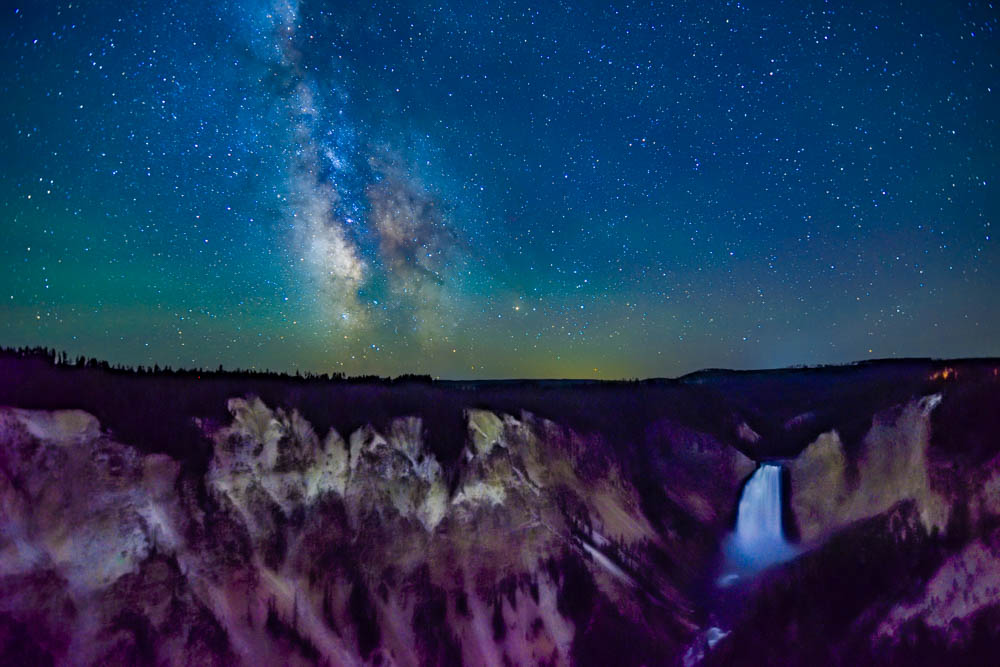
This week is International Dark Sky Week, a week devoted to enjoying dark skies and learning about how to protect them. Dark skies are fun for human purposes, for activities like stargazing or astrophotography, but there is far more to dark skies than just seeing stars. Darkness is actually an important part of the natural world.
Why darkness is important
All animals on Earth evolved within a world where a significant part of every day is dark, with only the exception of starlight and moonlight. Darkness has been part of life since the very first organism developed the ability to perceive light. Darkness has had a profound effect on the development of all life on Earth.
Artificial light disrupts all that. Many animals are nocturnal, evolved to thrive during the dark hours. The presence of bright lights at night can disrupt their ability to find food, avoid predators, and simply live a normal life.
For diurnal animals (creatures such as us, evolved to be awake during the day and to sleep at night), lighting up the night can disrupt sleep, which can in turn cause a number of health problems. Humans exposed to too much light at night produce less melatonin, a hormone that regulates sleep. That in turn can play a factor in health problems such as diabetes and heart disease, as well as mental health issues such as insomnia and depression.
Additionally, having lights on all night uses electricity needlessly, increasing energy usage and electric bills. At the wrong time of day, as well, for renewable energy, meaning it increases pollution from non-renewable electric plants. All for a false sense of security, since bright light blinds your eye to what lies beyond.
Okay, but why else?
We humans are strange creatures. It’s often difficult for us to act in our own self-interest to remain healthy, without some kind of external motivation. So how about the beauty and wonder of the night sky?
Most people in the US and Europe live in very light-polluted cities and suburbs, and may have never seen the night sky in its full glory. You may never have even seen the Milky Way! There’s a joke in the animated movie Madagascar where one of the zoo animals in New York City comments that “the star is out,” only to the light in the sky to turn out to be a helicopter. There’s some truth to that.
Stargazing can seem boring to those who are used to the night sky being just a scattering of a few of the brightest stars. I certainly used to think so. Then I came to Montana for the first time. There are places here – such as in Yellowstone – where the skies are among the darkest in the continental US. Seeing what’s actually up there, after a lifetime of never really looking up very much, opened my eyes to the magic of night.
Yellowstone’s dark skies
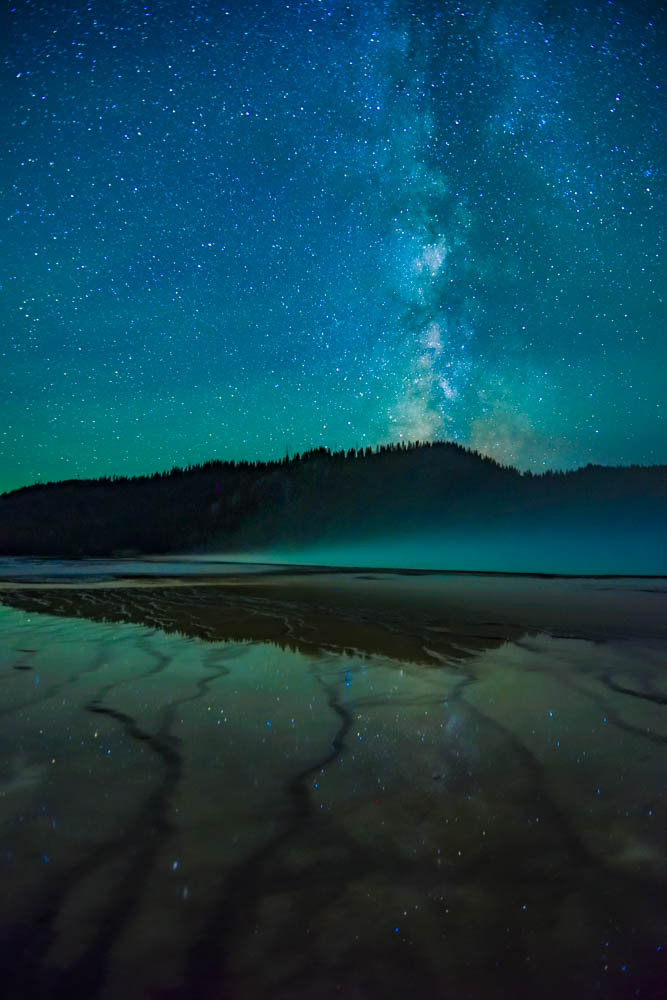
Consider this image as an example of what you can see from truly dark skies. This is the Milky Way above the Grand Prismatic pool in Yellowstone, looking to the southwest. Grand Prismatic itself is in a dark sky area, and the nearest sources of light pollution in that direction are far away, allowing ideal visibility of the stars and the Milky Way.
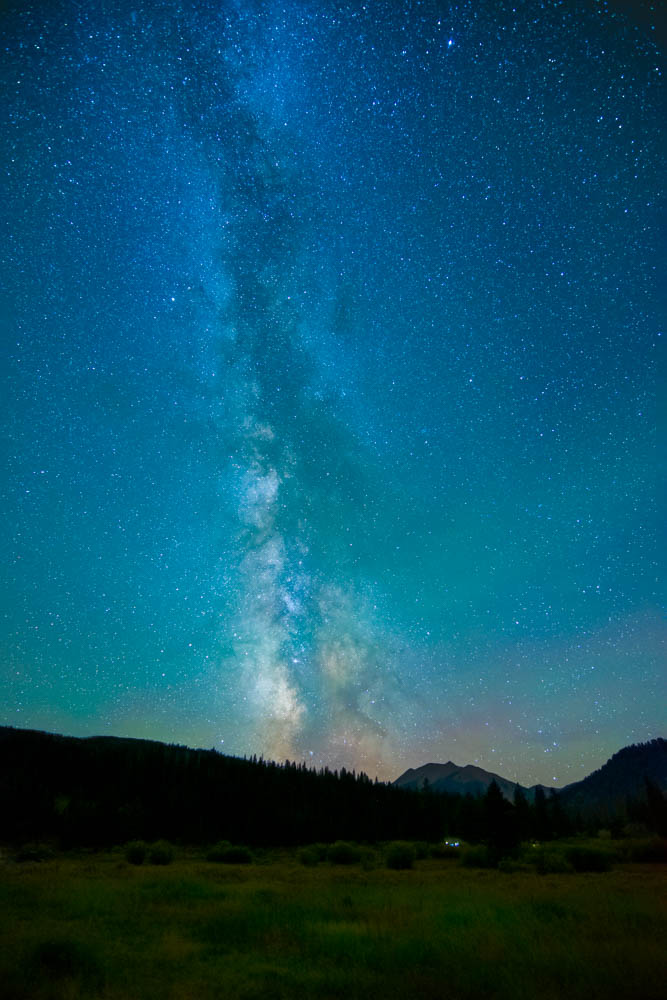
It’s not necessary to be inside of Yellowstone, of course. The following was taken down a forest service road in Montana, also in a very dark area. The only source of human light was from a small light at a campsite, which was only bright enough to add a little interest to the photo.
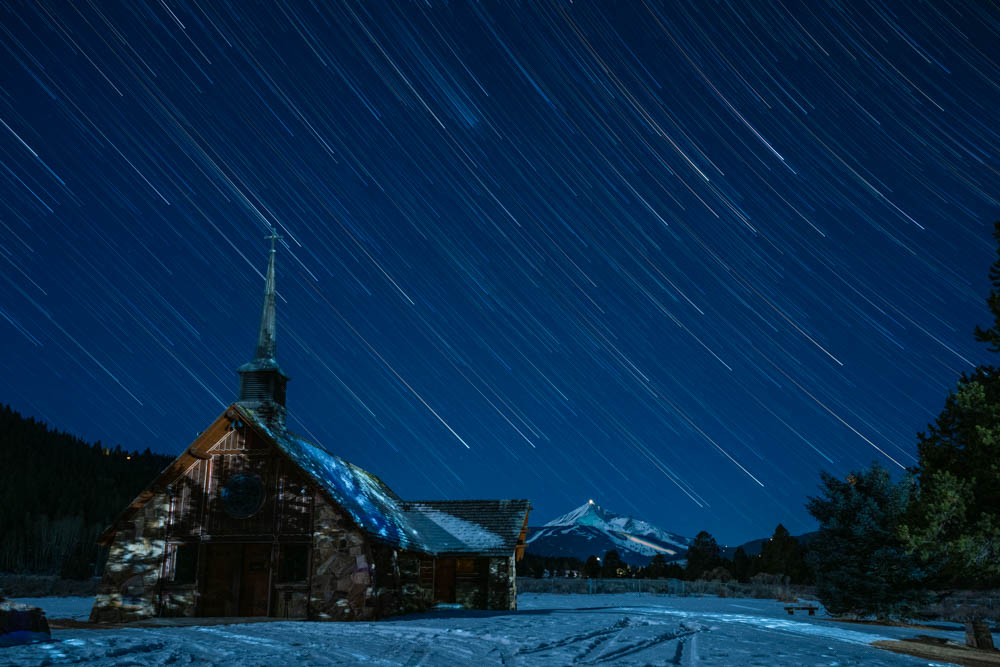
Astrophotography can still be done when there’s some light pollution, of course. The following is an example of star trails, taken in Big Sky, Montana. There are lights that remain on all night, and that don’t follow general dark sky rules. Still, this photo of Soldiers Chapel, with Lone Mountain in the background, works nicely.
I live in a city, what should I do?
First, do your part to reduce lights at night. Use exterior lights that point down, and don’t leave them on overnight. Also turn off interior lights when you go to bed. Use lights only when needed. Consider installing motion sensitive lights if you want light for security. Then you know to be alert if the light comes on, and a would-be thief may be scared away thinking someone’s home.
Second, get out and enjoy dark skies near where you live. There are a lot of different dark sky maps online, as well as apps for your phone. Find one that works for you, and it’ll show you where to go. Also be aware of the moon phase. While a full moon is also a lot of fun to look at, and it’s fun to go on nighttime walks lit by nothing but moonlight, a bright moon also washes out the sky, and is not ideal for stargazing.
If you happen to be near Yellowstone, and want to learn how to take photos of the night sky, we give astrophotography tours. Let us teach you how!