As we approach springtime in the Yellowstone area, many people are planning trips and are curious what there is to do in the area. You may have heard that snow tends to linger or about this time of year that locals call “mud season.” If you’re coming from warmer climes, this may intimidate you, but it shouldn’t. It’s a beautiful time of year, with a lot to see and do without the summer crowds.
Spring comes late
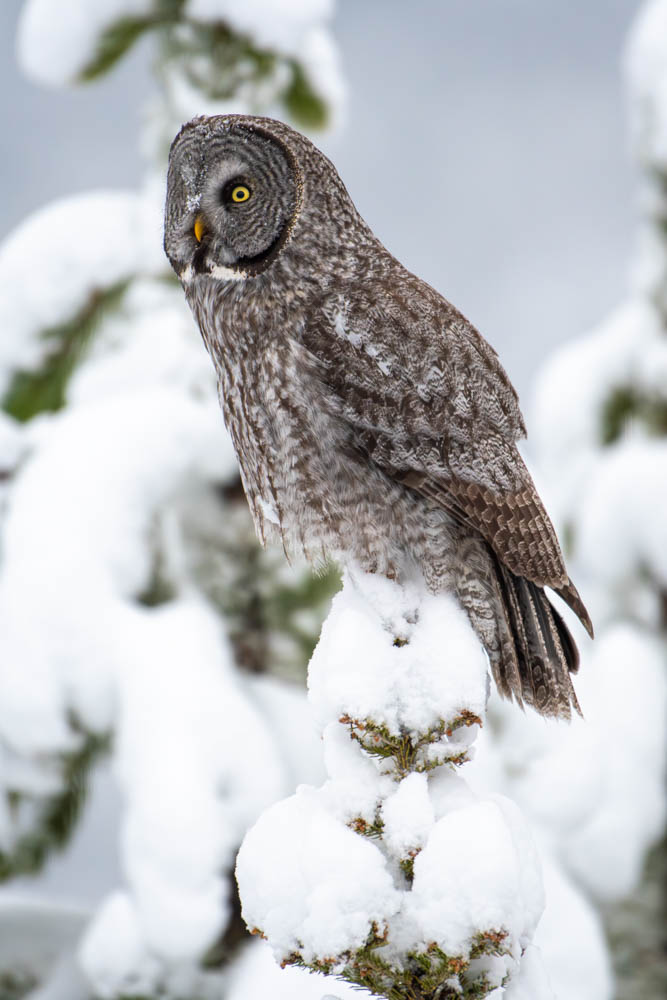
It’s true that spring comes late in this area, especially at higher elevations. Consider, for example, this photo of a great gray owl, seen on May 23, after a snow storm rolled through. Snow melts late in many places, and snow can fall into the early summer – or even throughout the entire summer in some very high elevation locations.
Snow adds a lot of magic and drama to Yellowstone landscapes, and can be extremely enjoyable, if you’re prepared for the conditions. Having warm clothing available is a necessity even throughout the summer.
However, barring the odd spring storm, most park roads are clear in early May, with all of them clearing up by late May. Although there will still be some snow on the ground, it won’t be deep.
By June, all park roads will be open and clear, and snow will be limited to patches in the shade, in places where snow was deeper, or at higher elevations.
Why should I brave the snow?
May and June are magical times in this area. The weather is warming, and animals are like children that have been cooped up indoors for too long. They’re out and visible, obviously enjoying the warmer weather after a long winter.
Even better, baby animals are starting to appear. This is your best time to see little bear cubs, and baby bison (also known as “red dogs” due to their size and color) are everywhere. If you’re lucky, you may also get to see wolf pups, coyote pups, fox kits, elk calves, mule deer fawns, and more.
If you’re a hiker, trails will be drying out in June, though you may still run into some mud in low spots or at higher elevations. All the boardwalks in the park should be fully clear of snow and ice, barring the very temporary and uncommon effects of a June snow storm.
Earlier in what many consider spring, in March and April, winter may still have a grip on this part of the world. Animals are still mostly in winter mode, but they’re very visible against the more plentiful snow.
Roads in the park are mostly closed to all traffic, including over-snow vehicles, with the exception of the north road from Mammoth to Cooke city, which is open year round. This is the best place to see wildlife, and a good time of year for that, but the road will have patches of ice. This is a good time to take a guided tour into the northern range of the park, as crowds will be almost nonexistent.
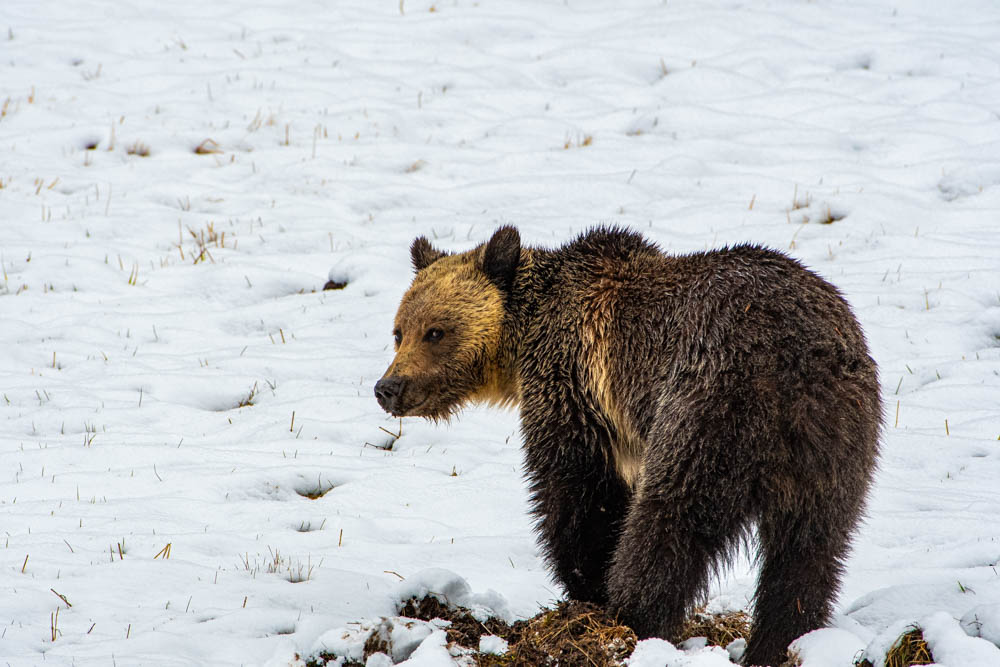
Although crowds will be picking up a bit in June, for most of the spring they’re quite minimal. On May 1 one year, when I got this photo of a grizzly in the snow, my son and I went into the Norris geyser basin and were literally the only ones there. Ours was the only car in the lot, and we saw nobody else the entire time.
To get a better idea of when you can drive on the roads in the park, see Yellowstone’s Park Roads page. If you expand the section titled Regular Vehicle Travel Dates, it will show you a map with the dates of operation of each section of road marked.
What can I do outside the park?
If you’re a skier – whether downhill, cross-country, or backcountry – Big Sky and West Yellowstone, and all along the road between the two, are great places to get in some spring skiing. Big Sky has a huge downhill ski area, and there are cross-country ski trails in many places along the section of highway 191 that is inside the park (but outside the park gates) as well as in West Yellowstone.
Backcountry skiing opportunities abound, though you’ll need to be careful. Avalanche danger can be high in certain places. Consider talking to a local at one of the ski shops in Big Sky to get the lowdown on how to stay safe.
If you’re looking for less snowy things to do, the Gardiner area gets far less snow and is usually completely clear at this time of year. There are many scenic drives and hikes near Gardiner, and in the Paradise Valley between Livingston and Gardiner.
You could also enjoy a trip over to Ennis, which is a cute little town just under an hour from Four Corners in Bozeman. Much of the drive from Bozeman goes through a winding mountain pass or along the Madison river, and you can enjoy exploring Ennis, Ennis Lake, and some of the hikes in the area. Like Gardiner, Ennis tends not to have as much snow.
You can also do things in all these places like fly fishing, snowmobiling or ATVing, dog sledding, horseback riding, and more. (Some of these depend, of course, on snow conditions and month.)
I need help planning!
Backroads Bear Adventures can help with your vacation planning. You can also visit the Visit Big Sky and Visit Gardiner sites, run by each city’s chamber of commerce, for ideas.
If you’re worried about driving in potentially snowy conditions in earlier spring, there are many different driving services that can get you from the Bozeman airport to lodgings in Big Sky, West Yellowstone, Gardiner, or inside the park. You can also book guided tours with companies (like us) whose drivers and vehicles are prepared for snow.
Whatever you do, don’t miss out on the opportunity to visit this area in the spring!
Leave a Reply